
Mechanik modellieren. Heilung untersuchen.
OSORA verbindet bildbasierte Rechenmodelle, mechanobiologische Simulation und datengetriebene Prognose.
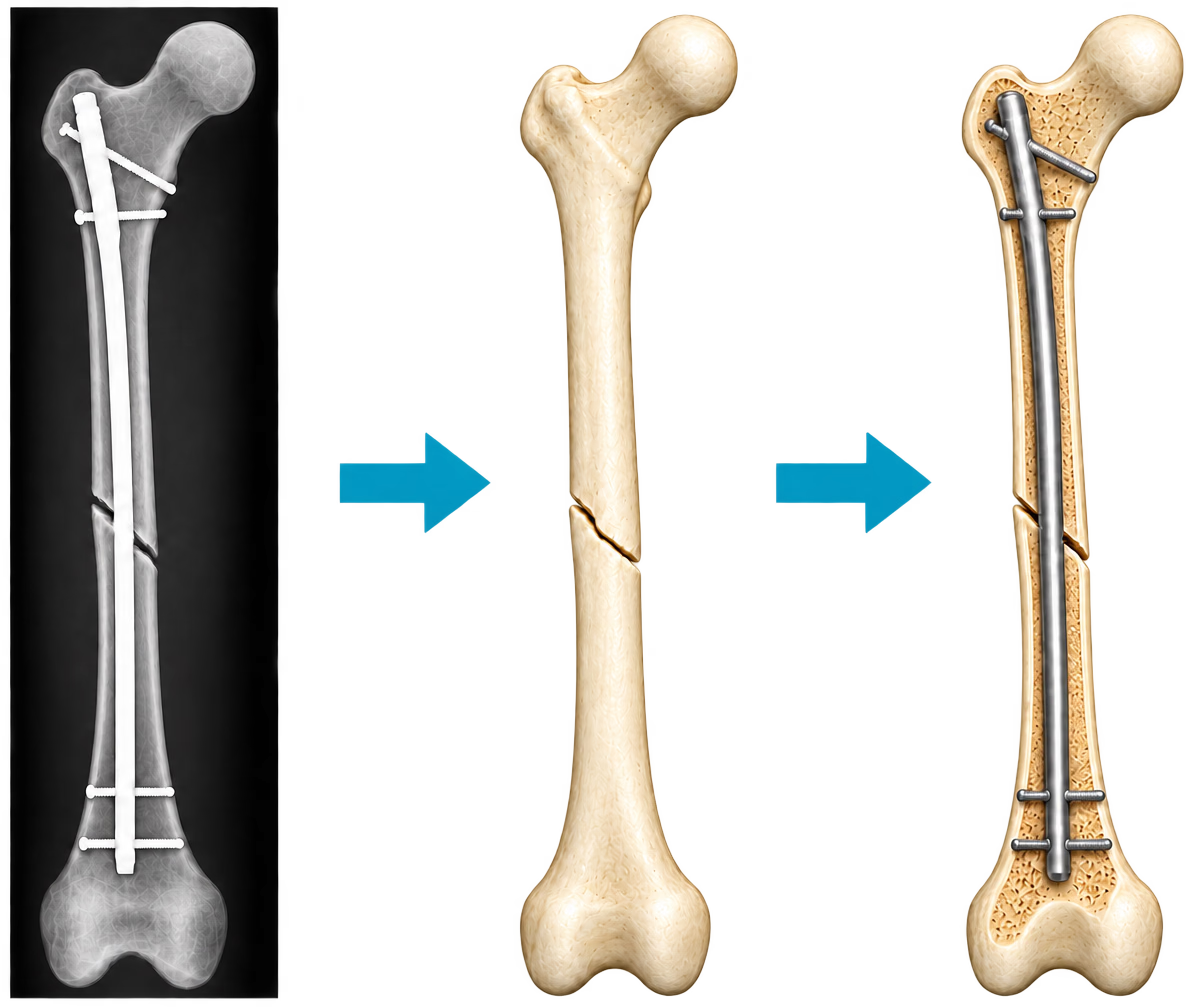
Von Fallinformationen zum digitalen Modell
Bildgebung, Informationen zu Fraktur und Versorgung sowie das Belastungsszenario bilden den Ausgangspunkt. Geometrie und Materialannahmen werden in ein Modell überführt, das die zu untersuchende Fragestellung abbildet.
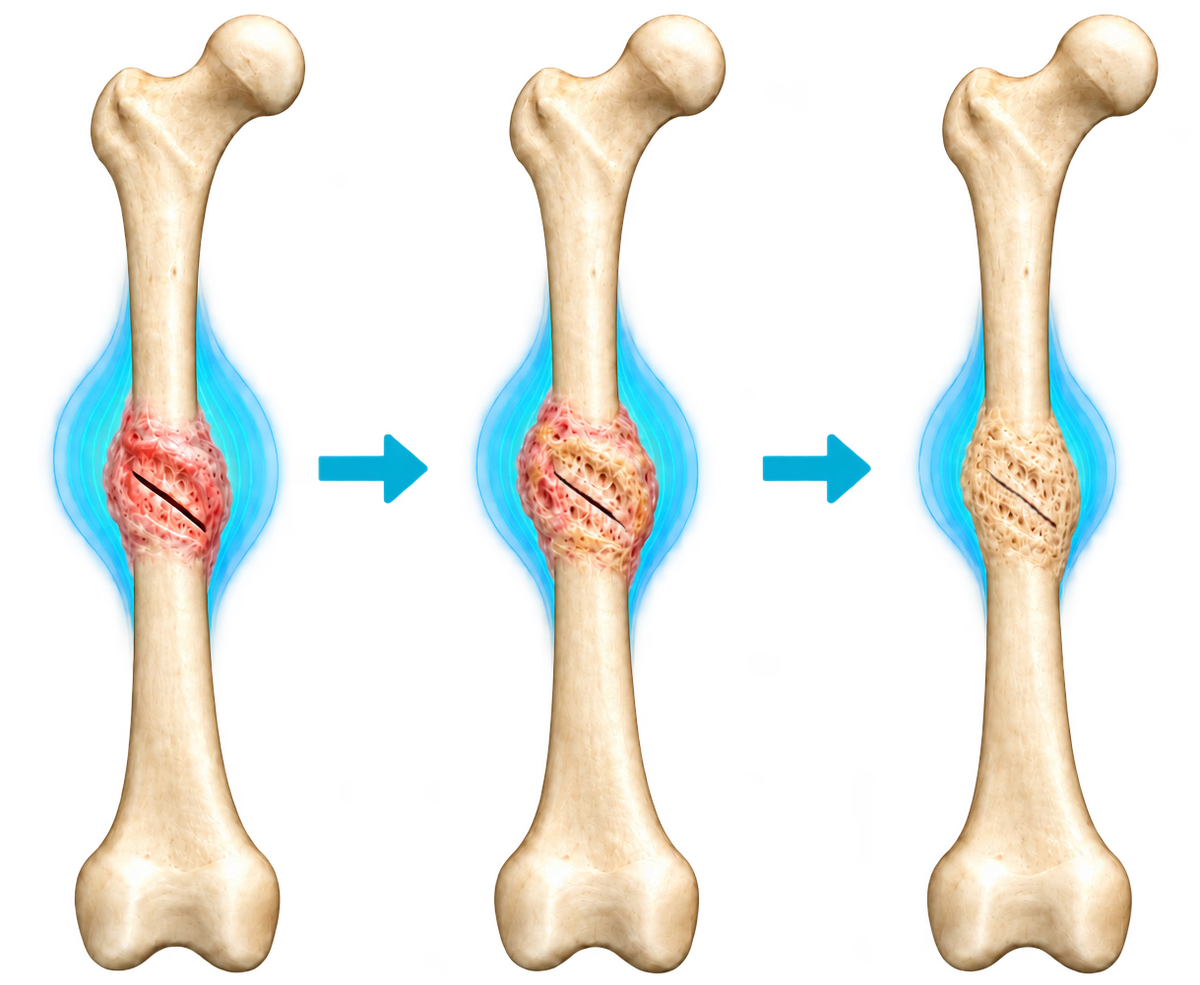
Mechanik prägt Heilung. Heilung verändert die Mechanik.
Lokale mechanische Bedingungen beeinflussen die Gewebeentwicklung. Mit dem Gewebe verändert sich auch das mechanische Umfeld. Wiederholte Simulationsschritte untersuchen diese Rückkopplung über den Heilungszeitraum.
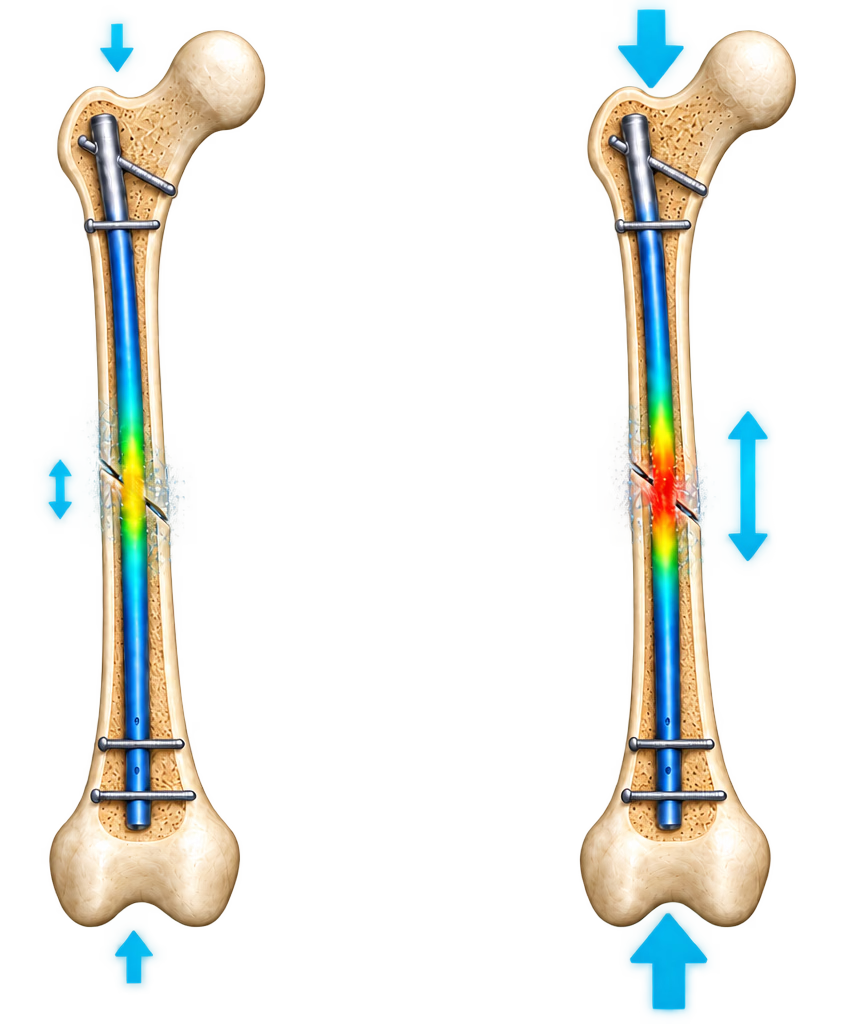
Szenarien vergleichen, nicht nur Momentaufnahmen
Eine praktische Fragestellung ist, ob eine höhere Belastung erlaubt werden kann, ohne übermäßige Bewegung im Frakturspalt oder hohe Implantatspannungen zu verursachen. Das Modell hält Fraktur und Versorgung konstant, verändert nur die Belastung und verfolgt, wie sich die resultierenden mechanischen Bedingungen auf die Konsolidierung auswirken können.
Auf Forschung aufgebaut. Im Kontext interpretiert.
Was das Modell untersuchen kann
Kontrollierte Szenarien können zeigen, wie sich Änderungen an Versorgung, Belastung oder Annahmen auf das simulierte Ergebnis auswirken.
Was im Kontext bleibt
Ergebnisse hängen von Datenqualität und gewähltem Modell ab. Sie unterstützen Forschung und Diskussion; sie belegen keine Gültigkeit für jeden Patienten und ersetzen keine klinische Beurteilung.
Veröffentlichungen und wissenschaftliche Grundlagen
- 2026
Predicting Nonunion: A hybrid machine learning model combining patient factors and mechanobiological simulation features exceeds clinician accuracy
Armbruster, J. et al. (2026)
Accepted for publication in Bone & Joint (forthcoming)
- 2026
Synergies between spaceflight research, bone healing models and digital twins
Arnegger, A., Niemeyer, F., (2026)
45th Annual Meeting of the International Society for Gravitational Physiology, Cologne, 2026
- 2026
Evolving Simulation-Based Education in Trauma Care: A User-Perspective on Implementation Requirements
Arnegger, A., Niemeyer, F., Mendel, T. (2026)
In: Proceedings of The 25th Annual Meeting of the International Society for Computer Assisted Orthopaedic Surgery , vol 8, pages 21-25
Veröffentlichung ansehen - 2025
Can fracture healing simulations improve clinical non union risk assessment? A retrospective study in 98 patients
Niemeyer, F., Armbruster, J., Engelhardt, L., Arnegger, A., Reiter, G., Grützner, P., Freischmidt, H. (2025)
30th congress of ther European Society of Biomechanics, Zurich, 2025
- 2025
The Power of Heuristics in Predicting Fracture Nonunion
Armbruster, J., Steinhausen, E., Hackl, S., Reumann, M., Stengel, D., Niemeyer, F., Reiter, G., Grützner, P., Freischmidt, H., (2025)
in: J. Clin. Med., 2713
Veröffentlichung ansehen - 2025
Does helical plating for proximal humeral shaft fractures benefit bone healing? – an in silico analysis in fracture healing: Fracture healing simulation of helical plating for humeral fractures
Halbauer, C., Capanni, F., Engelhardt, L., Paech, A., Knop, C., Merkle, T. and Da Silva, T. (2025)
Biomedical Engineering / Biomedizinische Technik., 2025
Veröffentlichung ansehen - 2024
Predicting non-unions in tibial shaft fractures: Can digital twins contribute to a reliable prognosis?
Armbruster, J, Engelhardt L, et al.
Deutscher Kongress für Orthopädie und Unfallchirurgie (DKOU), Berlin 2024
- 2024
Case Studies of a Simulation Workflow to Improve Bone Healing Assessment in Impending Non-Unions
Maisenbacher, T.C.; Libicher, S.; Erne, F.; Menger, M.M.; Reumann, M.K.; Schindler, Y.; Niemeyer, F.; Engelhardt, L.; Histing, T.; Braun, B.J.
J. Clin. Med. 2024, 13, 3922.
Veröffentlichung ansehen - 2023
Computer-Based Mechanobiological Fracture Healing Model Predicts Non-Union of Surgically Treated Diaphyseal Femur Fracture
Degenhart C, Engelhardt L, Niemeyer F, et al.
J. Clin. Med. 2023, 12 (10), 346
Veröffentlichung ansehen - 2023
An innovative web-based learning platform for improving knowledge and skills in fracture healing simulation in application to literature comparison of in-vivo data
Engelhardt L et al
X International Conference on Computational Bioengineering, Vienna 2023
Veröffentlichung ansehen - 2023
Einfluss der Mechanik auf die Pseudarthrosenentstehung und Ausheilung – ein zweischrittiges Simulationsverfahren für Screening und Detailanalyse
Braun B, Histing T
Deutscher Kongress für Orthopädie und Unfallchirurgie (DKOU), Berlin 2023
Veröffentlichung ansehen - 2023
The translational perspective
Engelhardt L
Invited Talk on the ORS ISFR Meeting 2023, Dallas
Veröffentlichung ansehen - 2022
Prognose des Konsolidierungszustandes operativ versorgter diaphysärer Femurfrakturen durch eine Computersimulation
Schütze K, Engelhardt L, Niemeyer F, et al.
Deutscher Kongress für Orthopädie und Unfallchirurgie (DKOU), Berlin 2022
Veröffentlichung ansehen - 2022
Klinische Anwendung der mechano-biologischen Frakturheilungssimulation zur Prognose des Konsolidierungszustandes operativ versorgter diaphysärer Femurfrakturen
Engelhardt L, Niemeyer F, Degenhardt C, et al.
Deutsche Gesellschaft für Biomechanik, Köln 2022
Veröffentlichung ansehen - 2021
Simulating Metaphyseal Fracture Healing in the Distal Radius
Engelhardt L, Niemeyer F, Christen P, et al.
Biomechanics. 2021;1(1):29–42.
Veröffentlichung ansehen - 2018
Including the Implant Degradation Process in a Fracture Healing Model
Pietsch M, Niemeyer F, Urban K, et al.
In: Proceedings of the 8th World Congress of Biomechanics. Dublin; 2018.
- 2018
Modelling the fracture-healing process as a moving-interface problem using an interface-capturing approach
Pietsch M, Niemeyer F, Simon U, et al.
Computer Methods in Biomechanics and Biomedical Engineering. 2018;0(0):1–9.
Veröffentlichung ansehen - 2018
Simulating lateral distraction osteogenesis
Niemeyer F, Claes L, Ignatius A, et al.
PLOS ONE. 2018;13(3):e0194500.
Veröffentlichung ansehen - 2017
Optimizing Spinal Fusion Implants Using Bone Healing Simulations
Niemeyer F, Trautwein F, Wilke H-J, et al.
In: Proceedings of the ORS 2017 Annual Meeting. San Diego; 2017.
- 2015
Numerical Simulation of Fracture Healing and Bone Remodelling
Simon U, Niemeyer F.
In: Simpson H, Augat P, eds. Experimental Research Methods in Orthopedics in Trauma. Stuttgart: Thieme; 2015:181–189.
- 2014
Adjusting Mechanoregulatory Rules for Numerical Fracture Healing Simulation from Sheep to Rat
Steiner M, Niemeyer F, Claes L, et al.
In: Proceedings of the 12th International Symposium on Computer Methods in Biomechanics and Biomedical Engineering. Amsterdam; 2014.
- 2014
Numerical Simulation of Callus Healing for Optimization of Fracture Fixation Stiffness
Steiner M, Claes L, Ignatius A, et al.
Costa-Rodrigues J, ed. PLoS ONE. 2014;9(7):e101370.
Veröffentlichung ansehen - 2014
Disadvantages of interfragmentary shear on fracture healing—mechanical insights through numerical simulation
Steiner M, Claes L, Ignatius A, et al.
J. Orthop. Res. 2014;32(7):865–872.
Veröffentlichung ansehen - 2014
Using bone healing simulations to design and optimize a novel spinal fusion implant
Niemeyer F, Bartolini L, Engelhardt L, et al.
In: Proceedings of the 12th International Symposium on Computer Methods in Biomechanics and Biomedical Engineering. Amsterdam; 2014.
- 2013
Prediction of fracture healing under axial loading, shear loading and bending is possible using distortional and dilatational strains as determining mechanical stimuli
Steiner M, Claes L, Ignatius A, et al.
J R Soc Interface. 2013;10(86):20130389.
Veröffentlichung ansehen - 2013
A New Bone Implant Concept: AMPLIFIX – First Numerical Results of Dynamic Osseointegration Simulation
Engelhardt L, Niemeyer F, et al.
In: CBU 2013 proceedings: 18th International Symposium on Computational Biomechanics in Ulm, 2013.
Veröffentlichung ansehen - 2012
Optimization of intramedullary nailing by numerical simulation of fracture healing
Wehner T, Claes L, Ignatius A, et al.
Journal of Orthopaedic Research. 2012;30(4):569–573.
Veröffentlichung ansehen - 2011
Optimization of Input Parameters for Fracture Healing Simulations
Steiner M, Claes L, Ignatius A, et al.
In: CBU 2011 proceedings: 17th International Symposium on Computational Biomechanics in Ulm, Jürgen Salk et al. (eds.).; 2011. Available at: http://vts.uni-ulm.de/doc.asp?id=7717.
- 2011
A numerical model of the fracture healing process that describes tissue development and revascularisation
Simon U, Augat P, Utz M, et al.
Computer Methods in Biomechanics and Biomedical Engineering. 2011;14(1):79–93.
Veröffentlichung ansehen - 2011
Effect of the fixator stiffness on the young regenerate bone after bone transport: Computational approach
Reina-Romo E, Gómez-Benito MJ, Domínguez J, et al.
Journal of Biomechanics. 2011;44(5):917–923.
Veröffentlichung ansehen - 2010
Influence of the fixation stability on the healing time — A numerical study of a patient-specific fracture healing process
Wehner T, Claes L, Niemeyer F, et al.
Clinical Biomechanics. 2010;25(6):606–612.
Veröffentlichung ansehen - 2010
Simulation of the Callus Distraction Treatment
Niemeyer F, Wehner T, Claes L, et al.
In: Proceedings of the 9th International Symposium on Computer Methods in Biomechanics & Biomedical Engineering. Valencia; 2010.
- 2009
Simulation of the nutrient supply in fracture healing
Chen G, Niemeyer F, Wehner T, et al.
J Biomech. 2009;42(15):2575–2583.
Veröffentlichung ansehen - 2006
Simulation of the Bone Healing Process
Simon U, Wehner T, Niemeyer F, et al.
In: Proceedings of ACUM 2006. Stuttgart; 2006.
- 2005
Trabecular bone fracture healing simulation with finite element analysis and fuzzy logic
Shefelbine SJ, Augat P, Claes L, et al.
Journal of Biomechanics . 2005;38(12):2440–2450.
Veröffentlichung ansehen - 2004
3D fracture healing model can help to explain delayed healing with interfragmentary shear movement compared to axial movement
Simon U, Augat P, Claes L.
In: Proceedings of the 6th International Symposium on Computer Methods in Biomechanics & Biomedical Engineering. Madrid; 2004.
- 2002
Dynamical Simulation of the Fracture Healing Process Including Vascularity
Simon U, Augat P, Claes L.
In: 13th Conference of the European Society of Biomechanics (ESB), Acta of Bioengineering and Biomechanics.Vol 4. Wroclaw, Poland; 2002.
- 2000
A fuzzy logic model of fracture healing
Ament C, Hofer EP.
J Biomech. 2000;33(8):961–968.
Veröffentlichung ansehen - 1999
Magnitudes of local stress and strain along bony surfaces predict the course and type of fracture healing
Claes LE, Heigele CA.
J Biomech. 1999;32(3):255–266.
Veröffentlichung ansehen